GOOD Search compared
What sets GOOD Search apart from the relevant alternatives?
For this comparison, we selected the seven most relevant search engines:
The table below reflects the criteria that to us as a values-based search engine matter most.
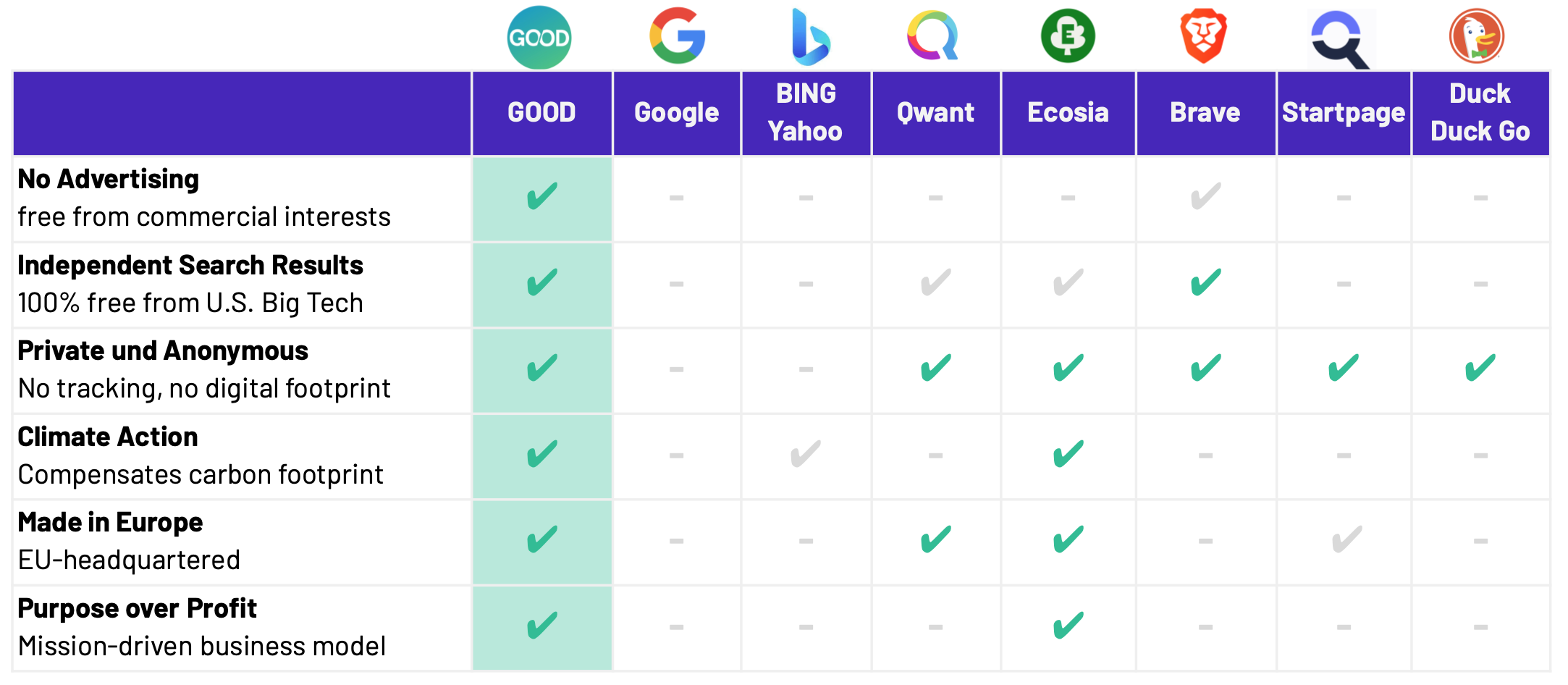
This is extremely rare. Google established and perfected the model of ad-funded web search: in 2025 alone, USD 225 billion was spent on sponsored links. Aside from GOOD Search, there are very few ad-free alternatives. Brave Search offers an optional ad-free version. There are also niche providers not listed here, such as the US startup Kagi or the non-profit metasearch engine MetaGer.
Search results without influence from Google or Microsoft Bing are also extremely rare. Even Qwant and Ecosia, which operate their own search feeds, only use them alongside results from Microsoft or Google, whose advertising networks their business models depend on.
GOOD Search relies exclusively on search feeds independent of US Big Tech: the feed developed by the Munich-based startup Cliqz (acquired by Brave Search in 2021), Mojeek (a project launched in 2004 that is fully independent of Google and Bing), and the newer “Staan” feed, developed by the French company Qwant since 2013 and further expanded since 2024 through a strategic partnership with Ecosia.
This is emphasized by most search engines positioning themselves as alternatives to Google or Bing. However, most providers are based in the US (DuckDuckGo, Brave) or owned by US companies (Startpage). With the exception of GOOD Search and Brave, all rely not only on search results from Microsoft or Google—two tech corporations that track user data wherever possible—but are also dependent on the advertising industry, whose goal is to build detailed user profiles.
This is the core focus of Ecosia, the search engine that plants trees. The monthly contribution each user makes to climate protection is actually higher with GOOD Search than with Ecosia; however, Ecosia invests in solar parks. Both startups consider the full spectrum of sustainability criteria and set their own priorities.
Less widely known: major US tech companies such as Google and Microsoft not only invest billions in energy-efficient data centers but are also active in carbon markets. Microsoft, for example, has pledged to offset all emissions ever produced since its founding through carbon credits. Whether this policy can be maintained given the rapidly increasing energy demand of AI applications remains to be seen.
True European players are Qwant, Ecosia, and GOOD Search. Qwant and Ecosia maintain strategic partnerships with Microsoft and Google, which somewhat contradicts their positioning as European alternatives. However, they are highly active at the political level, helping to strengthen Europe’s digital strategy and limit the power of US tech companies.
Startpage is headquartered in the Netherlands but was acquired in 2019 by the publicly listed US company System1, and is therefore not a true European player. Moreover, System1 specializes in performance marketing and ad tech, which undermines the credibility of its subsidiary as a privacy-focused search engine.
Ecosia and GOOD Search share a similar ambition: both were founded to create an alternative to the highly commercialized business models of Google, Bing, and others. Profits are reinvested socially or donated. Together with other companies that prioritize purpose over profit, they demonstrate that a different kind of economy is possible—entrepreneurial, but not driven by the goal of making the wealthy even wealthier.
There are also several other “social search engines” that have adopted Ecosia’s model, donating a portion (up to 50%) of their advertising revenue to good causes, but otherwise following traditional for-profit models: Lilo, Youcare, Karma Search, Ocean Hero.
Did you know? With MetaGer, there is another 100% non-profit alternative to Google – dating back to 1996, even before Google was founded. Operated by the non-profit SUMA e.V., affiliated with the University of Hannover, this search engine – like GOOD Search – is now financed through a subscription model supported by its community. The difference: while GOOD Search aims to source results from the best available providers, MetaGer requires users to choose a search algorithm, with usage billed via a token-based system.